
Decision Pipelines for Government™
For federal and state grant programs
Prevent the improper payment. Prove the decision.
For agencies that award federal grants and entitlements, post-payment recovery only finds what's already gone. Decision Pipelines for Government™ governs the award decision before disbursement — the accountability record that makes prevention auditable.
- GR-4471 Owner: J. Reyes Awarded $1.2M
- ENT-9920 Owner: P. Osei Eligible
- GR-4472 Owner: none · same entity Held for review
- GR-4473 Owner: M. Tan Ineligible
- ENT-9921 Owner: D. Hart Recertified
- GR-4472 Owner: J. Reyes · resolved Cleared: ineligible
Illustrative sample data.
Risk at the decision.
Duplicate identities, ineligible recipients, and override patterns surface as signals at the decision point — not at post-payment recovery. The engine raises them; a named owner decides.
Generate an IG-ready packet.
Owner, rationale, evidence, and outcome exported on demand. No six-week reconstruction sprint pulling files out of email.
Every award has a named owner.
Each consequential decision carries an owner on the record at the moment it's made. "Who approved this?" has an answer already.
Two halves of accountability
Detection recovers. Governance prevents.
Most agencies fund only the recovery half — and pay the reputational cost of every loss before they get a fraction of the dollar back. Decision Pipelines for Government™ closes the prevention half: every award decision required, owned, and on the record before the disbursement.
Prevention · Decision Pipelines
Govern the decision in flight.
Every funding decision carries a named owner, structured rationale, and the evidence it rests on — captured before disbursement, defensible after.
The gap
Detection alone starts after the loss.
Recovery is slow, partial, and the reputational damage lands first. By the time fraud is found, the dollar has moved.
Recovery · Fraud detection
Claw back what was paid.
Essential, but reactive. Post-award detection finds patterns, recovers funds, and refers cases — once the money is already out.
You need both. Most agencies only have one.
Where we sit
Accountability follows the dollar. Through every tier.
Decision Pipelines enters at the federal award decision and stays through the chain. Every decision and every signal in the disbursement lifecycle lands on the same append-only record.
Federal
Obligates the award
Agency awards funds and sets the terms.
State pass-through
Administers and allocates
Formula shares, eligibility rules, downstream awards.
Recipient
Receives and executes
Draws funds, runs the program, reports outcomes.
Subrecipient
Delivers on the ground
The furthest hop of the public trail; performs and reports back.
Above eligibility
Rules say who qualifies. We govern the decision made about edge cases, waivers, and overrides — with rationale and named owner attached.
Before the payment
A flagged award gets an owned, on-record decision — hold, clear, or escalate — before disbursement. Decision Pipelines records the decision; the payment system enforces it.
Beside audit
The next Inspector General or GAO review reads a structured decision record, not a reconstructed email trail.
Inside the workflow
Routing tools move the application along. We capture the decision the application represents.
Under the recipient
The Recipient portal issues Requests for Response and holds a commitment ledger — every response timestamped, with a named owner, on the record.
The record
The same five steps, across every award.
Every grant and entitlement decision becomes structured data — exportable on demand for IG review, audit reconstruction, or program reporting.
-
Signal
An application, renewal, or risk flag enters the queue with its evidence attached.
-
Owner
A named program officer takes the decision — on the record, at the moment it is made.
-
Decision
Award, deny, hold, or renew — with rationale and the evidence it rests on.
-
Action
Disbursement, denial notice, or escalation executes against the recorded decision.
-
Outcome
Result tracks back to the decision that produced it. Override quality is measurable, not assumed.
Eight archetypes. One record.
Award flows
- Competitive award — Scoring, tie-breaks, and reviewer rationale on the record.
- Formula allocation — Statutory share calculations with the inputs each rests on.
Recipient-side flows
- Eligibility determination — Rules, waivers, and edge-case calls owned before disbursement.
- Recertification — Continuation calls with the evidence each renewal rests on.
- Modification — Mid-award changes captured as first-class decisions.
- Payment authorization — Every drawdown owned at the decision, before the money moves.
Oversight flows
- Adverse action — Referrals, suspensions, and debarments on the same anatomy.
- Identity resolution — Duplicate EIN/SSN and shell-entity calls resolved on the record.
Program Integrity inherits evidence from every archetype — one improper-payment posture, one leadership-level view.
Risk Signals Engine
Risk surfaced at the decision.
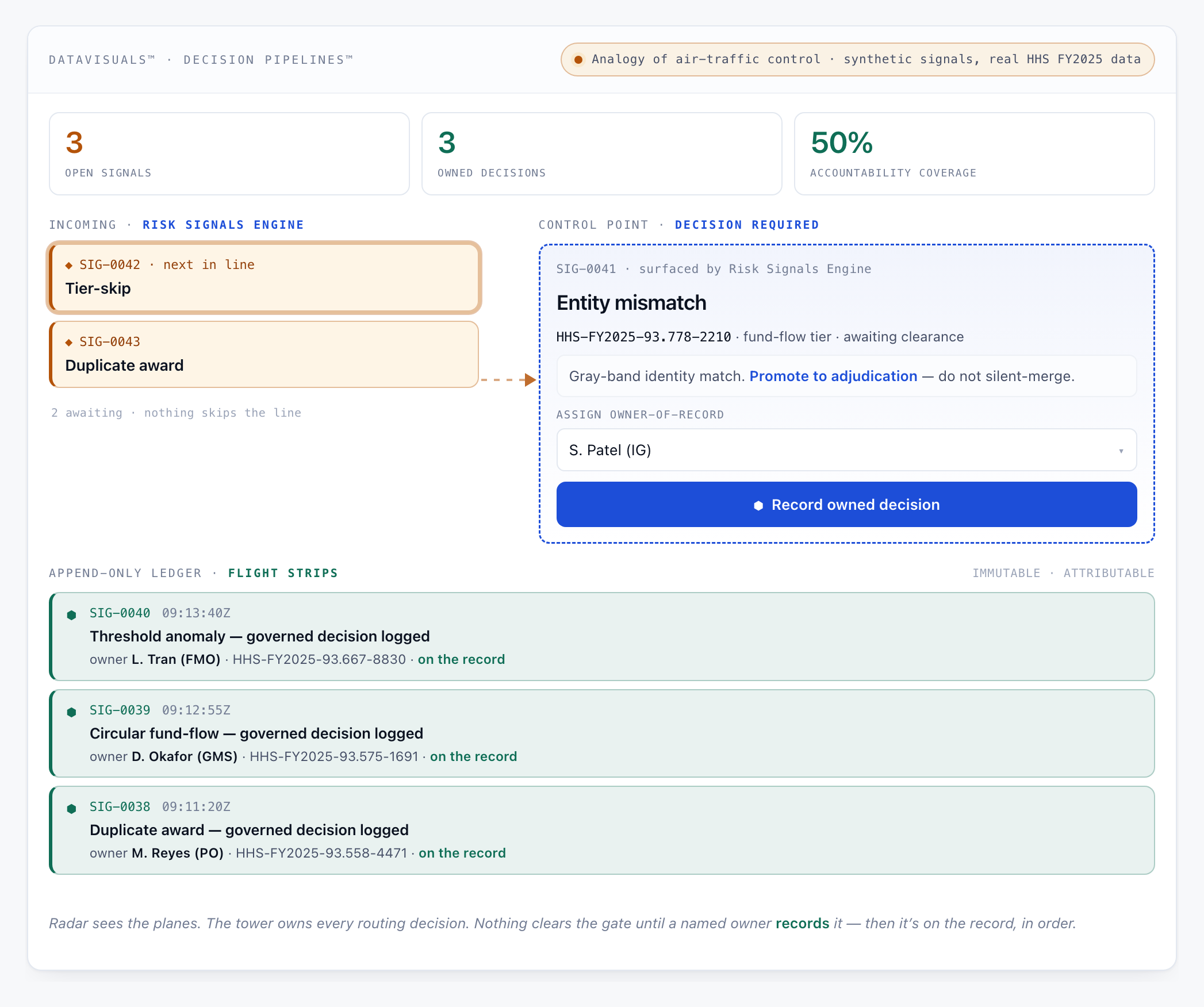
Every award runs through the Risk Signals Engine at the decision point. It flags fraud-risk indicators — duplicate identities, excluded parties, mismatched entities — and raises them as signals for an owned decision. The engine surfaces; a named owner decides.
Single record · Fraud-risk screening
Does this one record look wrong on its own? Known signatures, threshold breaches, and behavioral anomalies — no context required.
Entity · Identity resolution
Is this really the same entity? Conflicts and gray-band matches are promoted to a governed decision — never silently merged.
Chain · Fund-flow graph
Does this chain of money make sense? Conservation, cycles, skip-tiers, and orphans that only appear end to end.
Straight about what's live.
Oversight
The record oversight already asks for.
Every consequential award decision is captured to the frameworks oversight already runs on. Cycle findings, matters, exposure, and open signals roll up across every scope into one leadership-level record — and one export for the packet.

Oversight and authority
- OIG / GAO — reconstructability on demand
- FAR 1.602 / delegation orders — who was authorized to decide
- Privacy Act / SORN — recipient PII, retained by the rule
Security and access
- NIST 800-53 (AU family) — audit and accountability logging
- FIPS 140-3 — encryption in transit and at rest
- CAC / PIV — smartcard sign-in
- Section 508 — accessible by mandate
Export and interoperability
- Structured decision record — JSON/CSV export
- Tamper-evident audit log — NIST 800-53 AU
- API — into existing case and payment systems
Prove it in five minutes. Not five weeks.
Inside the workspace
What you'll see in a briefing.
Two walk-throughs of the current build. Demos use illustrative sample data, including synthetic oversight findings — not actual OIG or GAO audits.
Walk-through 01 Product overview
Login, Matters register, Signals rail, Recipient portal. How the surfaces connect.
Walk-through 02 Award Decisions Inspector
Owner, rationale, evidence, integrity check, and outcome — the single record that becomes the packet.
Get started
Govern the award before you have to recover it.
Request a briefing for your program. We'll map Decision Pipelines to your highest-exposure funding decisions and show the IG-ready record it produces.