
AI decisions
The AI nobody approved.
Most of your AI didn’t arrive through procurement — it arrived as a feature toggle. A vendor shipped a scoring model in the last release and someone in Lending switched it on. No contract, no invoice line, nothing for vendor management to catch. It never reaches an AI inventory, because nobody files a procurement decision for a checkbox.
We catch it, because it was already a Lending decision. It just gets tagged.
- Filed in the home workflow
- Examiner-ready export
- Not a separate product
$1.2M a year in AI. One asset in production that nobody approved.
Twelve assets. Five reviews overdue. One fraud-scoring model in production with no approving decision on file — $95,000 a year, no owner sign-off, no rationale.
Illustrative finding · Riverdale Community Credit Union is a fictional institution.
The gap
What goes wrong without it
AI adoption outran governance. The spend is real, the approvals are informal, and the board is starting to ask.
Shadow AI
Models, tools, and agents in production that no inventory has ever counted.
Unsigned spend
Annual AI cost climbing across business units with no formal approval on file.
Promises never measured
A vendor promised a result. Nobody recorded the claim, and nobody checked it.
No answer for the board
“Who approved this, and on what authority?” — and the record doesn’t exist.
The capability
Two surfaces, one record
The inventory the operator works, and the packet the board reads. Same underlying decisions.
Walk-through
Walk the AI register.
See a governed AI portfolio the way an operator works it — every asset, its owner, its spend, and its review state, with the board packet one click away.
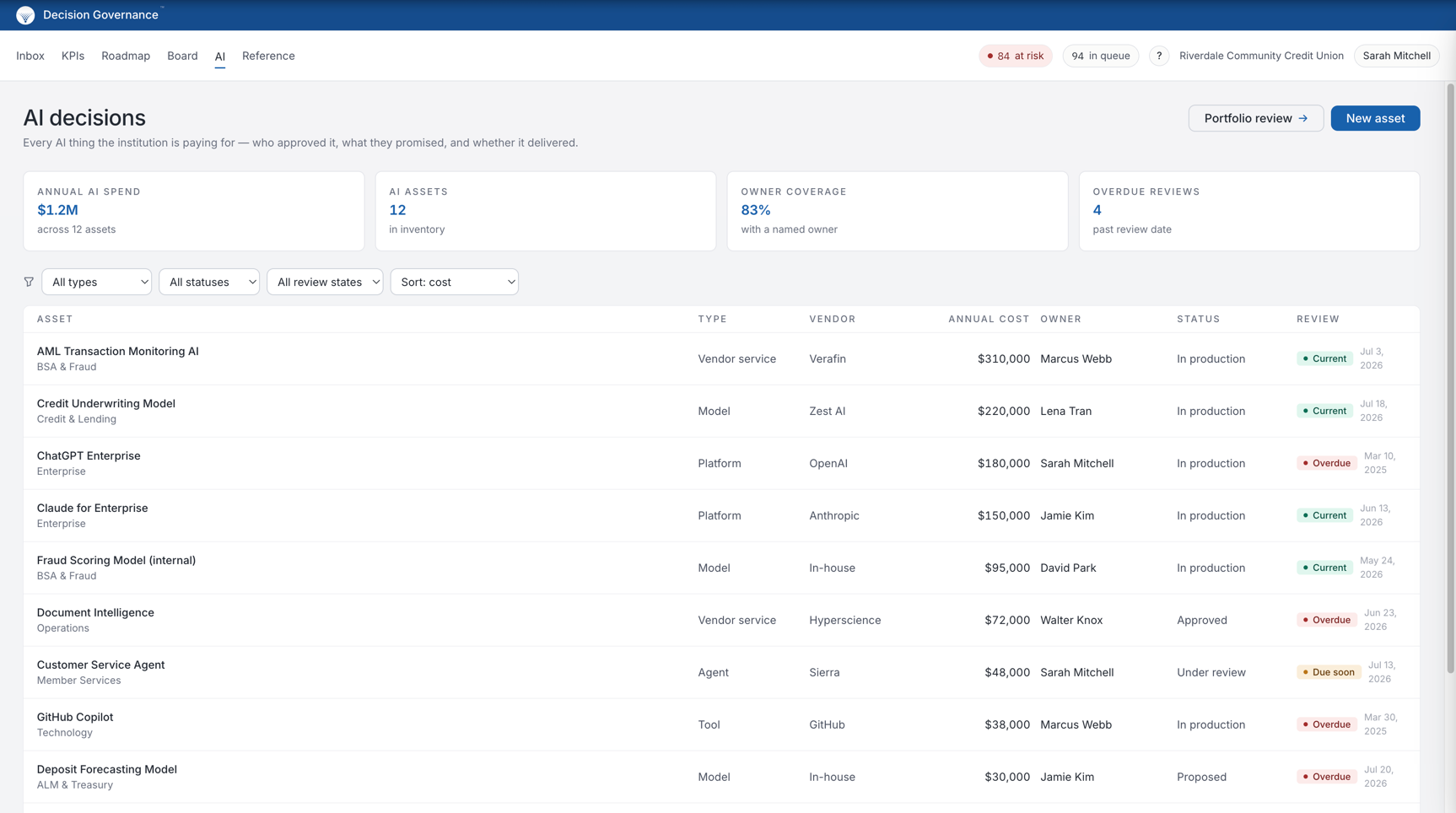
01 · THE INVENTORY
The inventory nobody has.
Every governed AI asset in one place — spend, owner, status, and review state at a glance.
- Annual AI spend, owner coverage, and overdue reviews across the portfolio
- Every asset with type, vendor, cost, owner, status, and review state
- Filter by type, status, or review state — sort by cost or urgency
02 · THE INTAKE
Nothing gets in without an owner.
Register any AI asset — model, platform, agent, or vendor service — with the fields that make it governable from day one.
- Type, vendor, business unit, and annual cost — with a cost basis when the number isn’t known yet
- Owner and status captured at intake, so nothing enters the inventory unaccountable
- Set the approved-use boundary up front — the constraints the approval actually established

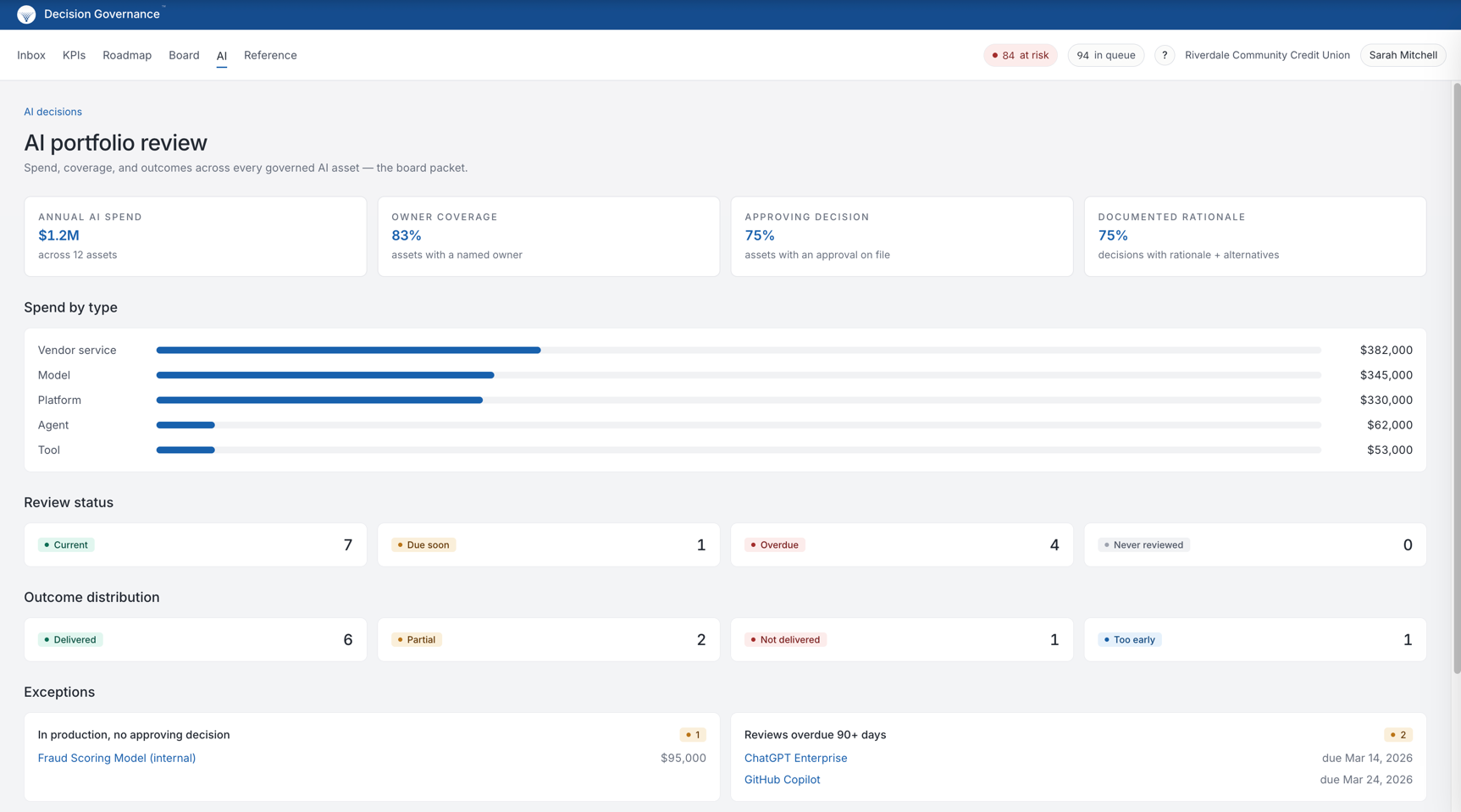
03 · THE BOARD PACKET
The board packet, on demand.
Spend, coverage, and outcomes across every governed AI asset — the document the board opens.
- Spend by type, owner coverage, approving-decision and rationale coverage
- Review status and outcome distribution — delivered, partial, not delivered
- Exceptions surfaced: in production with no approval, reviews overdue 90+ days
04 · THE EVIDENCE
How the AI was actually used.
Follow rate, override rate, and boundary compliance computed from decision records — measured, not attested — with every exception surfaced.
- Model use: follow, override, and consultation rates, plus boundary compliance
- Exceptions surfaced: shadow AI, decisions outside boundary, overrides above threshold, reviews overdue
- Governance posture scored on the six DGMM facets — only as governed as its weakest one

How it fits
AI isn’t a workflow. It’s a lens.
AI shows up three ways, and the record holds all three: a register of what you run; decisions about AI — adopt, enable, retire — filed in the workflow that owns them; and model attribution — when a model was the instrument, what it recommended and what the human did with it. This page reads across all three; it doesn’t split them off into a separate product.
Model soundness is governed in Workflow 06 — Model risk management. AI decisions are filed where the work lives — the CLO owns the Lending AI call, not a separate team.
And the guidance itself names a live gap: SR 26-2, the model-risk standard examiners use, deliberately leaves generative and agentic AI out of scope — the Federal Reserve is still soliciting input on how to govern them. A copilot switched on in the LOS, a chatbot answering members, an agent drafting adverse-action language: none of it is a “model” under SR 26-2, and none of it waits for the guidance to catch up. The register, the tag, and model attribution give you a defensible record for it today.
The inventory the board will ask for — before they ask.
Boards are asking for the AI inventory now. This is the version that answers the follow-ups — who approved it, on what basis, with what authority, and whether it delivered.
Illustrative data throughout. Riverdale Community Credit Union is a fictional institution.