
For the Chief Risk Officer
“Who approved this?” should not require an investigation.
You own accountability for decisions made across nine functions by people who don't report to you. Today, proving who owned a decision means asking around. That's the gap.
What happens today
The exam letter arrives. You have thirty days. The decision was made fourteen months ago in a meeting whose notes live in someone's OneDrive, based on a dashboard that has since refreshed, by a manager who has since left.
So you reconstruct. Email threads, calendar invites, whoever remembers. Six weeks of senior staff time to rebuild a record that should have existed the day the call was made.
The reconstruction is usually accurate. It's just not evidence.
What changes
- Every decision has a named owner at the time it’s made. Not assigned afterward. Not inferred from an approval chain. Named, on the record, when the call happens.
- Rationale is captured as structured data, not prose. Why this call, against what policy, on what evidence, with what authority. The evidence attaches itself — dashboards, model outputs, and alerts flow onto the record from systems already in production.
- Override patterns become visible at portfolio level. Not one exception at a time — the shape of them. Who overrides, how often, in which workflow, with what outcome.
- Aging surfaces before an examiner does. Decisions without an owner, or sitting past their window, appear on your dashboard first.
What you’d actually see
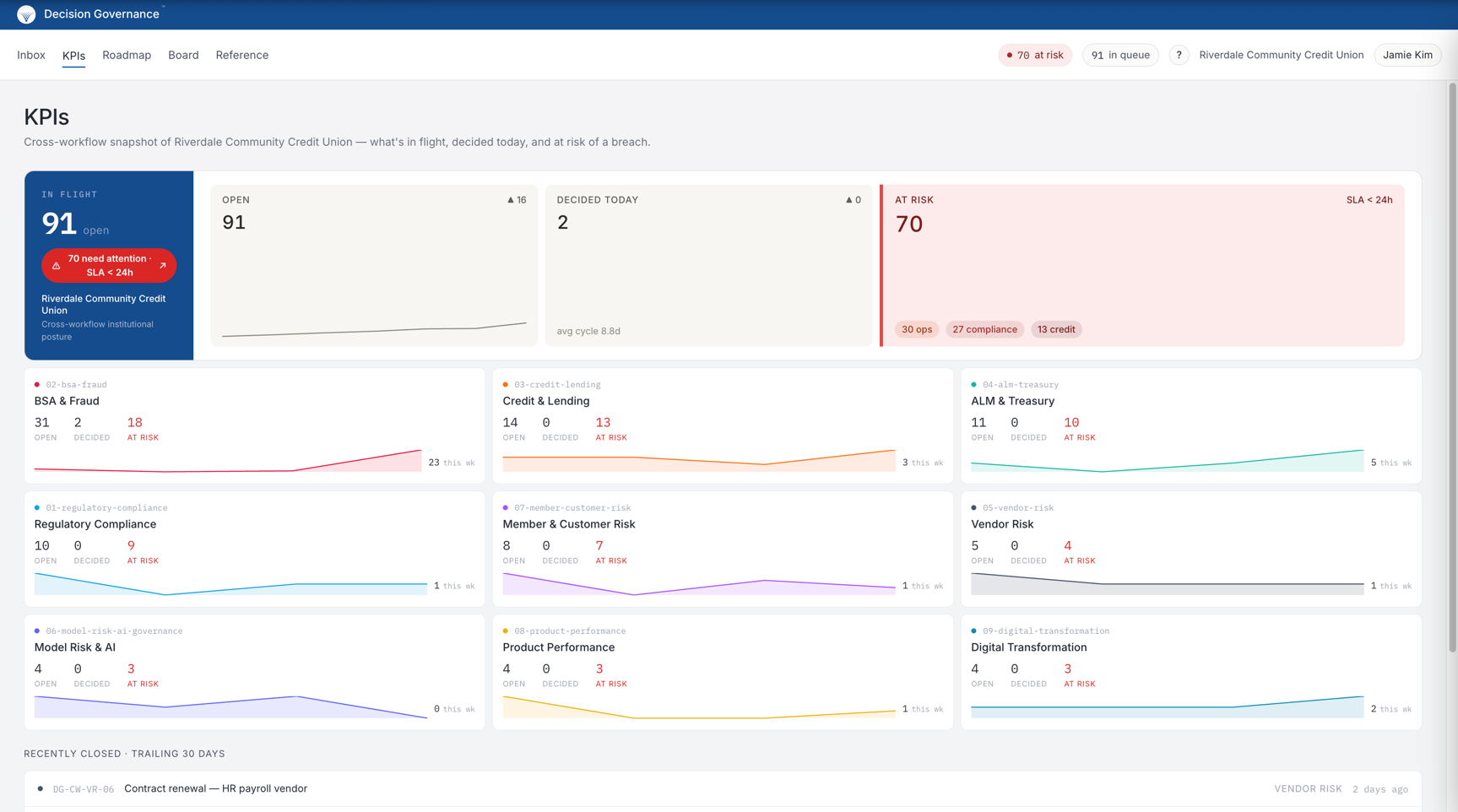
Nine operational workflows feed one board-and-strategic layer. Lending, BSA, treasury, vendor, compliance, model risk, member risk, product, digital. Same five-stage record in every one. Exportable on demand.
Where you stand today
Six minutes, self-scored, private. Six facets: ownership, authority, timeliness, ability to reconstruct, override discipline, and board linkage. You get a placement and a gap list you can take to your next risk committee — whether or not you ever talk to us.
Not your question? See the General Counsel view